Φ-Framework Report: NVIDIA Corporation
Organizational coherence analysis through the See / Spec / Split lens
I. The Company at a Glance
NVIDIA, founded by Jensen Huang, Chris Malachowsky, and Curtis Priem in 1993, has become the most valuable company on Earth by market capitalization. What began as a graphics chip company is now the backbone of the AI revolution: 88% of its $216B revenue comes from Data Center (AI infrastructure), with Gaming (9%), Professional Visualization (1.4%), and Automotive (1.3%) composing the rest.
The organizational design claim: radically flat, CEO-centric, information-transparent. Jensen Huang has 60 direct reports. He holds no one-on-one meetings. He reads 100 “Top Five Things” emails every morning. He shares strategy with everyone simultaneously. “The mission is the boss,” not internal politics or career ladders.
The actual structure reveals contradictions the design claims do not acknowledge.
II. Declared Organizational Structure
Huang’s organizational philosophy rests on five interlocking principles:
| Principle | Mechanism | Φ Channel |
|---|---|---|
| 60 direct reports | Eliminates middle management layers; CEO reaches all parts of the org directly | Φcomm (group meetings) |
| No 1:1 meetings | All feedback given in group settings; everyone hears the same reasoning | Φsurface (public information) |
| Top Five emails | 100+ daily summaries from across the org; CEO “stochastically samples the system” | Φsurface (upward visibility) |
| “Mission is the boss” | Decisions based on customer/mission need, not internal politics or career advancement | Φrule (decision criterion) |
| No 5-year plans | Strategy communicated in real-time; direction adjusts continuously to market signals | Φcomm (live reasoning) |
The company reports two operating segments (Data Center, and Gaming/Professional Visualization/Automotive), but the functional reality is organized around product domains with deep vertical integration from chip architecture through CUDA software to developer ecosystem.
III. The Benevolent Bottleneck
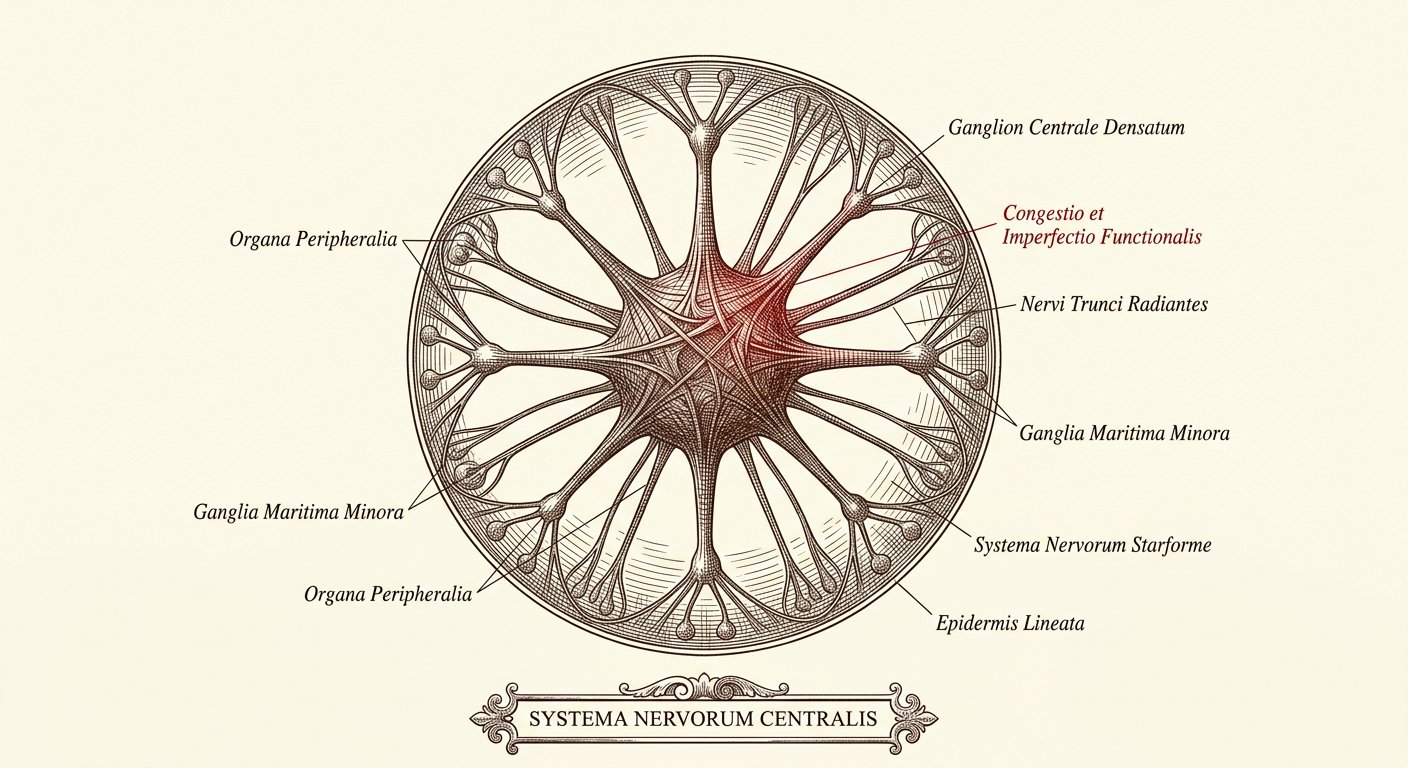
NVIDIA’s organizational design inverts Valve’s. Valve distributes authority and hides it. NVIDIA concentrates authority in Jensen Huang and broadcasts it. He functions as the single routing node through which all strategic information flows, and unlike Valve’s shadow hierarchy, this concentration is declared and visible.
The 60-direct-report structure with no 1:1 meetings creates a distinct organizational physics:
1. The Broadcast Model
Huang gives feedback in group settings so all 60 leaders hear the same reasoning. This is a deliberate Φsurface design: by making his decision-making process public, he converts tacit judgment into shared context. Every executive learns not just what Jensen decided, but how and why.
2. The Stochastic Sampler
The Top Five emails system gives Huang direct access to ground-truth signals from any level of the organization, bypassing the normal information loss that occurs at each management layer. He reads ~100 per morning, using them to “stochastically sample the system” and detect drift before it compounds. He optimizes for sensor density, not micromanagement: sample enough signals to hold a coherent model of 42,000 people.
3. The Pressure Cooker
The 42,000 employees below the 60 direct reports bear the cost. Meetings run to 30+ attendees. Former employees describe them as “contentious, with shouting and fighting.” Engineers work until 2am. The culture normalizes seven-day weeks. Some employees attend ten meetings per day. NVIDIA’s Glassdoor work-life balance rating: 4.0/5. The reviews behind that number describe a workplace where the stock price is the primary coping mechanism.
Employee turnover plummeted from 5.3% in 2023 to 2.5% in 2025. When the stock went from $300 to $1,400+, the quarterly RSU vesting schedule became golden handcuffs worth millions. People stay because leaving means forfeiting millions, even though the pace is unsustainable. Selection relaxation applied to talent retention: the stock subsidy masks the coordination cost that employees absorb.
IV. Φ-Channel Analysis
| Channel | Domain | Evidence | Level |
|---|---|---|---|
| Φsurface | Upward (Top 5 emails) | 100+ daily summaries reach CEO directly; ground-truth signal from all org levels | high |
| Φsurface | Downward (broadcast) | Strategy shared with everyone simultaneously; no privileged information channels | high |
| Φsurface | Lateral (cross-team) | No evidence of structured cross-team visibility tools; coordination happens in the 30-person meetings or not at all | low |
| Φformal | Decision criteria | “Mission is the boss” is a documented, shared decision principle enforced by Jensen’s direct involvement | high |
| Φformal | Chip design | TSMC partnership, tape-out processes, silicon validation. Deep engineering protocols refined over decades. Full R/F/K triad present. | high |
| Φformal | Work-life boundaries | No norms, no limits. 2am finishes, 7-day weeks. No failure detector (F) for burnout, no recovery mechanism (K). | absent |
| Φtacit | Engineering culture | 32 years of accumulated coordination patterns. Jensen’s judgment as the implicit protocol for cross-domain tradeoffs. Fragile to succession. | high |
| Φtacit | Supply allocation | Entire 2025 Blackwell production sold out before shipping. Allocation driven by relationship-based prioritization, not transparent documented criteria. | moderate |
| Φcomm | CEO–org communication | Jensen-to-all is world-class. But 30+ person meetings are communication theater, not dialogue | misallocated |
| Φcomm | Peer coordination | 60 leaders competing for airtime in group settings; lateral collaboration must route through Jensen or happen informally | low |
V. Where Time Dies
| Queue | What Waits | Why It Waits | Severity |
|---|---|---|---|
| Jensen’s attention | Decisions that need CEO input across 60 report lines | Star topology: no delegation protocol for decisions below CEO threshold. Every strategic question routes to Jensen. | Critical |
| Cross-team coordination | Work that spans Data Center, Software, and Operations | 60 leaders in group meetings can’t negotiate bilateral priorities. Lateral coordination has no dedicated channel. | Critical |
| Supply allocation | Customers waiting for Blackwell/GB200 chips | Entire 2025 production pre-sold. 2-year GPU lead times. Allocation criteria opaque to non-hyperscale customers. | High |
| Employee bandwidth | Quality work that requires rest, focus, and recovery | No Φrule for work boundaries. 2am finishes, 7-day weeks. Stock price masks burnout. Sustainability traded for intensity. | High |
| Meeting throughput | Decisions and alignment across 30+ person meetings | 10 meetings/day × 30 people = thousands of person-hours consumed. Signal-to-noise ratio degrades with group size. | High |
| Non-Data-Center innovation | Gaming, Automotive, Robotics product development | 88% revenue concentration in Data Center creates gravitational pull on talent and attention. “Mission is the boss” and the mission is AI infrastructure. | High |
VI. The Paradox of the Benevolent Autocrat
Jensen Huang personally functions as the Φsurface (reads the Top 5 emails, holds the system model), the Φtacit (his cross-domain judgment is the implicit protocol for org-level tradeoffs), and the Φcomm hub (broadcasts to everyone, receives from everyone). All coordination channels for strategic decisions converge in one person.
This concentration produced the fastest large-company pivot in tech history: from gaming GPUs to AI infrastructure, with no committees, no consensus processes, no political negotiation. Jensen saw the market shift, told everyone simultaneously, and they built it.
NVIDIA’s coherence and its fragility share the same source. Jensen’s cognitive bandwidth is the binding constraint. As headcount grows from 42,000 toward 60,000+, the Top 5 emails get noisier, the 30-person meetings get more crowded, and the star topology carries more load per node. The bandwidth does not scale with the org.
What subsidizes this? The same mechanism as Valve: 65% revenue growth and 71% gross margins (Corollary 5b). At 65% year-over-year revenue growth and 71% gross margins, the organizational model needs speed, not efficiency. Jensen’s star topology is fast, as long as the star holds and the margins absorb the coordination waste that 60 leaders cannot resolve laterally.
VII. See / Spec / Split Applied
1. See the Queue
Jensen sees the whole system through Top 5 emails. Nobody else does. The 60 direct reports see their own domains but have no structured visibility into each other’s work, priorities, or blockers.
First move: Create a shared leadership dashboard visible to all 60 direct reports showing cross-domain dependencies, bottlenecks, and Jensen’s current priority focus. For lateral coordination, not control. Let the 60 leaders self-organize without routing everything through the hub.
2. Spec the Handoff
“Mission is the boss” is a powerful decision criterion but it doesn’t define handoffs. When does a chip architecture decision become a software optimization decision? When does a supply chain constraint become a product roadmap constraint? These boundaries are currently navigated through Jensen’s judgment.
Second move: For each major cross-domain boundary (silicon→software, engineering→supply chain, product→customer allocation), define what “ready for the next team” means. Encode Jensen’s judgment into protocols that can operate when he’s not in the room.
3. Split the Traffic
Not every decision needs Jensen. But in a 60-direct-report model with no 1:1s, there’s no lightweight escalation path. Everything is either a 30-person meeting or a Top 5 email.
Third move: Explicitly tier decisions. Tier 1: Jensen decides (existential bets, platform shifts, key customer relationships). Tier 2: domain leads decide with peer review (product roadmap, engineering tradeoffs, hiring). Tier 3: teams decide autonomously with post-hoc visibility (implementation details, operational calls). Today, the tiers exist informally. Encoding them would let the org scale without every thread going through the same needle.
VIII. The Succession Question
NVIDIA’s Φtacit/Φformal ratio for org-level coordination is among the highest of any large company. Jensen’s cross-domain judgment functions as the routing layer, the sensor network, the decision protocol, and the broadcast channel. Removing him would simultaneously eliminate the primary Φtacit carrier and expose the absence of Φformal underneath. The framework predicts a deep reorganization valley (Prediction 4).
NVIDIA has no known succession plan, no COO, and no “Office of the CEO.” The Jensen built the 60-direct-report model around his own cognitive capacity. Any successor would need to either replicate Jensen’s bandwidth (unlikely) or restructure the organization around distributed Φformal (disruptive, but the only path that scales past the founder).
NVIDIA’s deepest structural risk: what happens to a $3 trillion company whose entire coordination architecture is one person’s working memory?
IX. Summary Assessment
| Dimension | Rating | Notes |
|---|---|---|
| Φsurface (vertical) | Exceptional | Top 5 emails + broadcast strategy. Best-in-class upward/downward visibility. |
| Φsurface (lateral) | Weak | 60 leaders can’t see each other’s state. No cross-domain dashboard. |
| Φformal (strategy) | Strong | “Mission is the boss” is clear, shared, and enforced. |
| Φformal (engineering) | Strong | Chip design, TSMC processes, CUDA platform. Deep, mature protocols with full R/F/K. |
| Φformal (work boundaries) | Absent | No norms on hours. No burnout detection (F) or recovery (K). Stock absorbs the cost. |
| Φtacit | Strong | 32 years of accumulated engineering culture. Jensen’s cross-domain judgment as implicit protocol. Very high tacit-to-formal ratio at org level. |
| Φcomm (CEO→org) | Exceptional | Jensen’s broadcast model eliminates information asymmetry at the top. |
| Φcomm (peer→peer) | Weak | 30-person meetings dilute dialogue. No lightweight lateral channel. |
| Succession readiness | Critical risk | Org architecture = one person. No COO, no Office of CEO, no succession plan. |
| Financial resilience | Exceptional | $216B revenue, 71% gross margins, $36B cash, near-zero debt. |
| Talent retention | Fragile | 2.5% turnover masked by golden handcuffs. If stock flattens, the pressure cooker has no lid. |
Four coordination channels, one parent:
Φsurface: substrates that make state visible without conversation.
Φformal: documented protocols that encode expectations without negotiation.
Φtacit: learned routines and institutional memory. Accumulates with time, destroyed by reorgs and turnover.
Φcomm: real-time human communication. Most expressive, most expensive, least scalable.
Φrule = Φformal + Φtacit: total protocol capacity.
SEE the queue — make work visible
SPEC the handoff — define “ready”
SPLIT the traffic — not everything needs the bottleneck
Applied recursively. Stop at the compression floor.